Chapter 1 — Why Do Cardiovascular CFD Models Need Reduced-Order Representations?
Computational fluid dynamics (CFD) provides a powerful way to investigate blood flow within anatomically detailed cardiovascular geometries. Three-dimensional models can resolve local velocity fields, pressure distributions, complex flow structures, and quantities such as wall shear stress that cannot be obtained from simpler system-level descriptions. Yet even a highly detailed cardiovascular CFD model represents only a limited portion of the complete circulation.
Consider a patient-specific model of the aorta. The computational domain may include the ascending aorta, the aortic arch and its major branches, the descending thoracic and abdominal aorta, and perhaps the iliac arteries. At some point, however, every branch must be truncated to create an outlet surface. These outlets are computational boundaries—not physiological endpoints. In the body, blood continues through progressively smaller arteries, arterioles, capillaries, and eventually the venous circulation.
The important point is that this unresolved downstream vasculature does not become irrelevant simply because it is absent from the three-dimensional geometry. Peripheral vascular resistance, arterial compliance, and the rest of the circulatory system continue to influence the pressure and flow within the arteries that are explicitly modeled. The behavior predicted inside a 3D cardiovascular domain can therefore depend strongly on how its outlets are represented. This dependence on downstream boundary conditions has long been recognized in cardiovascular flow modeling [1].
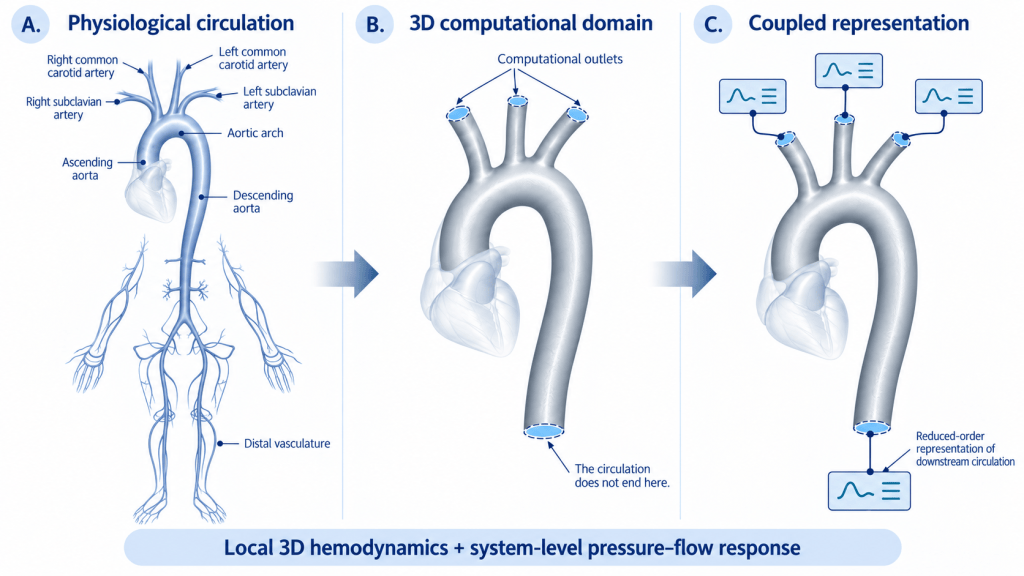
Figure 1.1. Connecting a finite three-dimensional cardiovascular domain to the unresolved circulation. A CFD model explicitly represents only a limited portion of the cardiovascular system. Although the distal vasculature is not included in the three-dimensional geometry, it continues to influence pressure and flow within the modeled domain. Reduced-order models provide an efficient means of representing this downstream cardiovascular response.
What should happen at a CFD outlet?
This is one of the central questions in cardiovascular CFD.
A simple option is to prescribe a fixed pressure at an outlet. For example, a zero-gauge-pressure boundary condition is straightforward to implement and may be adequate for some computational questions. However, it does not by itself represent the dynamic behavior of the vascular bed downstream of that outlet. In a multi-branch arterial model, applying identical outlet pressures can cause the predicted flow distribution to depend primarily on the resistance of the explicitly modeled branches while neglecting much of the resistance associated with the downstream vascular territories [1].
The practical consequences can be substantial. In a patient-specific aortic CFD study comparing several outlet-boundary-condition strategies, Pirola and colleagues found that well-tuned three-element Windkessel conditions provided the best overall agreement with measured flow data while also producing physiological pressure behavior. In contrast, zero-pressure conditions applied at multiple outlets failed to reproduce physiologically meaningful pressure and flow characteristics in that particular model [2].
Another option is to prescribe the desired flow rate—or a fixed percentage of total flow—at each outlet. This can be useful when reliable measurements are available and the research question requires a known flow distribution. But it changes the nature of the problem: the branch flow is now imposed, rather than emerging from the interaction between the modeled artery and the downstream circulation.
In reality, arterial pressure and flow are dynamically linked. The peripheral circulation resists blood flow, compliant vessels temporarily store and release blood, and pulsatile waves generated by the heart interact with the vascular system throughout the cardiac cycle. Representing this behavior requires more than simply assigning a pressure or flow value to the end of a 3D vessel.
This is where reduced-order cardiovascular models become useful.
Instead of explicitly constructing and meshing the enormous network of vessels beyond every CFD outlet, the unresolved circulation can be represented using a much smaller mathematical model. Zero-dimensional (0D), or lumped-parameter, models are particularly attractive for this purpose because they can describe system-level pressure–flow relationships with relatively few variables and at very low computational cost. They are widely used both as stand-alone representations of cardiovascular physiology and as components of multiscale models that provide boundary conditions to local 3D simulations [3].
Key idea: A CFD outlet is a computational boundary, not the end of the cardiovascular system. A reduced-order model allows the influence of the unresolved circulation to remain connected to the three-dimensional domain.
The two modeling approaches therefore answer different but complementary questions. A three-dimensional model provides detailed information about where and how blood moves locally, whereas a reduced-order model can describe how the modeled region interacts with the larger cardiovascular system. Coupling these levels of description provides a practical way to retain high spatial detail where it is needed without attempting to model the entire circulation in three dimensions.
The next question is therefore a fundamental one: what exactly does “zero-dimensional” mean? To answer it, we need to look at what information is retained—and what spatial information is deliberately removed—when a blood vessel or vascular network is converted into a lumped-parameter model.
References
[1] Vignon-Clementel IE, Figueroa CA, Jansen KE, Taylor CA. Outflow boundary conditions for three-dimensional finite element modeling of blood flow and pressure in arteries. Computer Methods in Applied Mechanics and Engineering. 2006;195:3776–3796. DOI: 10.1016/j.cma.2005.04.014.
[2] Pirola S, et al. On the choice of outlet boundary conditions for patient-specific analysis of aortic flow using computational fluid dynamics. Journal of Biomechanics. 2017;60:15–21. DOI: 10.1016/j.jbiomech.2017.06.005.
[3] Shi Y, Lawford P, Hose R. Review of zero-D and 1-D models of blood flow in the cardiovascular system. BioMedical Engineering OnLine. 2011;10:33. DOI: 10.1186/1475-925X-10-33.
